
Pike County Parole and Probation
Parole and probation can both place a released Pike County person under rules in the community, but they begin in different ways. The State Board of Pardons and Paroles decides whether an eligible person leaves Georgia Department of Corrections custody on parole. A Georgia court orders probation as part of a sentence. The Department of Community Supervision, or DCS, supervises felony parolees, probationers, people on reprieve, and people serving split sentences in the community.
A bond release from Pike County Jail is not parole. It also does not prove probation. Someone may leave the jail while the criminal case remains open, while another person may complete prison and begin parole. The sentence, state custody history, and supervision record must agree.
| Point | Parole | Probation |
|---|---|---|
| Source | Parole Board decision after a state sentence | Court sentence or order |
| Prior custody | Release from GDC before the maximum date | May replace confinement or follow a jail or prison term |
| Public starting record | PAP Parolee Search | Pike County court docket and sentence |
| Local supervision | DCS Griffin Field Office | DCS Griffin for felony probation |
| End point | Parole discharge or sentence expiration | Court-ordered term ends or court grants discharge |
Several terms help separate the records:
- Parole
- Conditional community release from a state prison sentence by the Parole Board.
- Probation
- A court-ordered period of community supervision.
- Split sentence
- A sentence combining confinement with probation.
- Discharge
- The formal end of a supervision term.
- Absconder
- A supervised person alleged to have stopped reporting or left supervision without permission.
Verify Pike County Release Supervision
Begin with the source of the sentence. The public tools do not form one combined Pike County supervision list. A person released from GDC to parole belongs in the parole path. A person ordered to felony probation belongs in the court and DCS path. A person who merely bonded out of Pike County Jail may be in neither system.
- Search the GDC offender query if the case led to state custody. Include inactive offenders, and compare the GDC ID, conviction county, offense, age, and most recent institution.
- For someone already released on parole, use the PAP Parolee Search. It accepts first name, last name, race, and gender.
- For a person still awaiting parole review, use the Inmate TPM Lookup. A tentative parole month is a review point, not proof of release.
- Check the Pike County Superior Court sentence or disposition for probation, a split sentence, revocation, or discharge. The clerk maintains the official court record.
- Confirm the assigned office or current public status with the DCS Griffin Field Office. For a precise record, use the agency's open-records channel.
Names alone can mislead. A GDC ID or case number is more reliable. If the public result conflicts with a court order, ask the originating agency to verify it. The full county release and court-record path is described on the Pike County released inmates search.
Important: A current Pike County Jail roster would show custody, not post-release parole or probation. Released status must be checked in the system that owns the sentence or supervision.
Pike County DCS Griffin Office
Pike County does not have a separate DCS field office in Zebulon. The official Griffin Field Office page places Pike with Fayette, the Griffin Circuit, Spalding, and Upson. That regional setup matters after release. The sheriff confirms a county jail event, while DCS handles felony community supervision.
Georgia DCS Griffin Field Office
700 Legacy Park Dr
Barnesville, GA 30204
Monday-Friday, 8:00 a.m.-4:30 p.m.
Coordinating Chief Shannon (Shane) Driver: 770-358-5047
Fax: 404-937-6358
Gina Rodgers, Pike/Upson/Fayette information: 770-296-9590
The named Pike contact can help route an office question, but a phone response is not a substitute for the sentencing order or a formal agency record. DCS maintains a separate Open Records Custodian for releasable supervision records. Agency records may be subject to billing and exemptions.
Before calling, have the full legal name, date of birth, case number, and GDC ID if known. Ask which office serves the case and what public channel can confirm status. Staff may limit phone disclosures, so a focused records request can provide a more durable answer.
The official field-office screenshot comes from the same DCS source used for the Pike supervision route.
View the DCS Griffin Field Office source before comparing the page image.
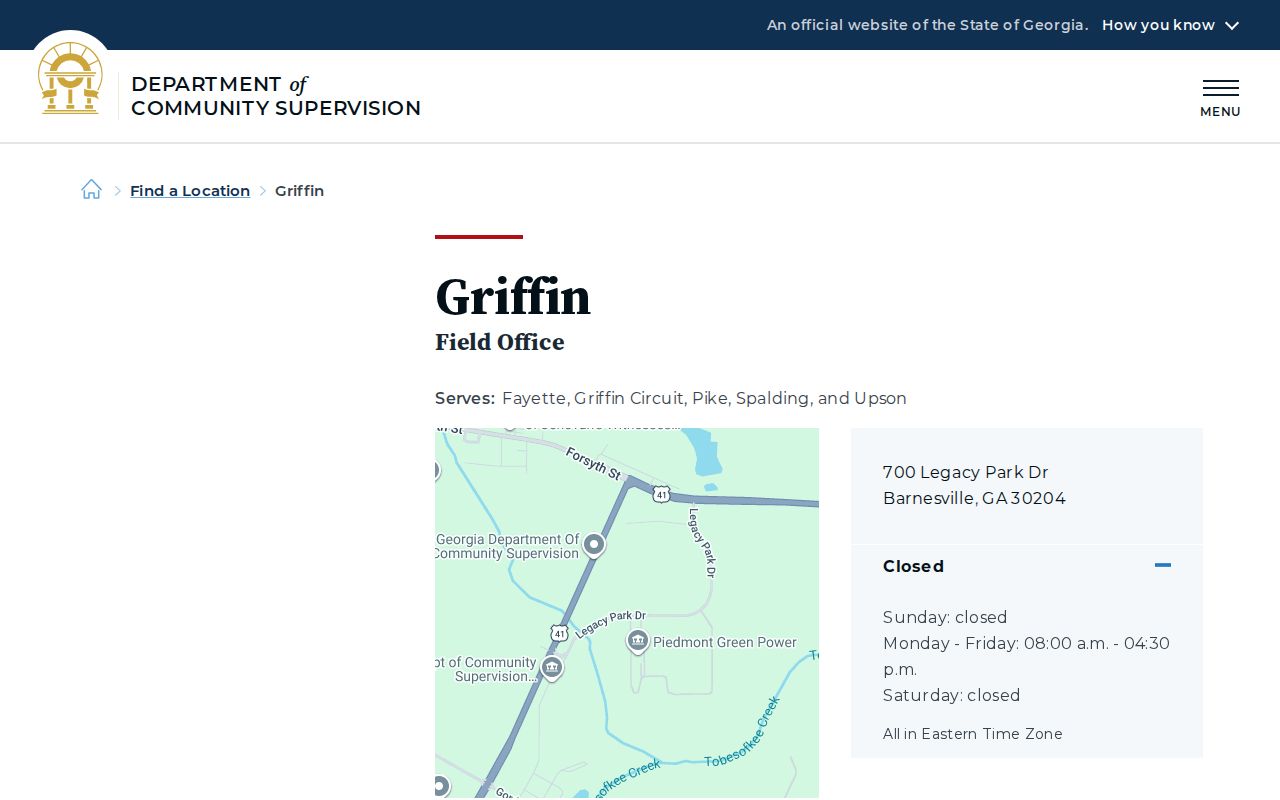
It confirms that Pike supervision is routed through Barnesville rather than a Pike office in Zebulon.
Pike Release Violations and Absconders
Conditions depend on the sentence and supervision plan. At a high level, they can require reporting, lawful conduct, payment or program duties, travel approval, and compliance with special court or Board terms. The actual order controls. A violation claim can lead to an administrative response, court proceeding, warrant, revocation, or a return to custody, depending on the kind of supervision and alleged conduct.
No official Pike County public absconder list was found in the research. Do not infer a warrant from a missed call, an old address, or a general search result. Check the PAP result for parole status, contact the DCS office, review the Pike court docket for probation or revocation entries, and use sheriff warrant records when a warrant is the question. Georgia VINE may report a later custody change, but it is not an absconder ledger.
A transfer also needs care. “Not in Pike County Jail” can mean release to the community, transfer to GDC, or custody under another authority. The new agency record determines what happened next.
Note: An allegation of absconding is not the same as a final revocation or a new conviction.
Pike County Supervision Discharge Records
Supervision ends through the authority that imposed it. Parole may end through discharge or sentence expiration under the Board's framework. Probation ends under the court sentence, later court order, or other lawful discharge. A person who is no longer reporting should not automatically be described as discharged. The public status, DCS record, and court docket must support that conclusion.
For probation, ask the Pike County Clerk of Superior Court for the sentencing order, any amended order, revocation record, and discharge entry. For parole, check PAP and request a releasable status or decision record if the public result is not enough. Georgia's Open Records Act, O.C.G.A. 50-18-70 et seq., provides a request process, but exemptions may apply to parts of supervision and parole files.
Record restriction is separate from discharge. O.C.G.A. 35-3-37 can restrict eligible criminal history records through the statutory process. It does not rewrite a supervision end date or turn an incomplete public result into proof that supervision ended.
Pike Parole Meetings and Decisions
Georgia parole meeting notices are statewide, not a Pike County hearing calendar. PAP posts events and meeting notices when scheduled. During the research period, its page could show no upcoming events. PAP also posted an amended June 2026 agenda and a July 2026 cancellation, which shows why a fixed monthly assumption is unsafe.
Person-specific status comes from a different tool. For an incarcerated person, the TPM lookup may show when final review is expected. The Board may set a future tentative month or deny parole, and it may reconsider a decision before release. For someone already out, the Parolee Search is the relevant public path. Neither a meeting agenda nor a TPM proves that a Pike County person was released.
Most parole-eligible Georgia inmates are eligible for consideration after one-third of the sentence, according to PAP, but eligibility is not release. Serious violent felony rules, recidivist status, minimum terms, life sentences, and offense dates can change or bar eligibility. A common claim that every Georgia person serves 85 percent is not a safe substitute for the actual sentence and PAP rules.
Pike County Release and Reentry
No Pike County-run reentry office was documented. The accurate local route is the state network: PAP provides parole and reentry material, while DCS felony supervision connects released people to their assigned field office. Claiming a local program without a source could send someone to the wrong place.
Reentry and supervision are related but not identical. A handbook or service referral may help with transition needs, while the DCS reporting instructions remain mandatory under the actual supervision plan. The Pike contact at the Griffin Field Office is the practical place to confirm where a felony-supervised person should report. Court staff can explain the record location but cannot replace DCS reporting instructions.
The source page below shows how DCS describes felony supervision statewide.
Review the DCS felony supervision source for the agency's role.
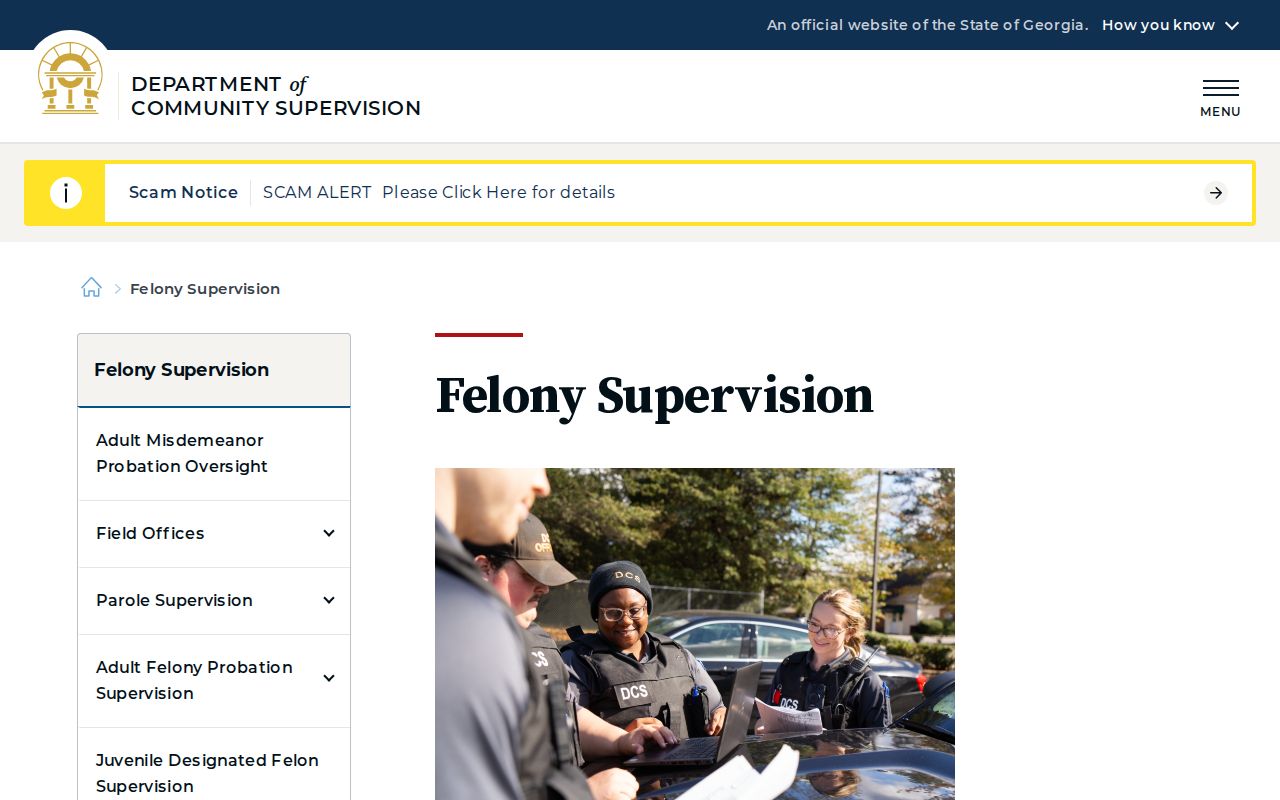
The state framework supports Pike parole and felony probation after release through the regional office.