
Pike Projected and Actual Release
A projected date is a calculation or planning point. It is not the event itself. For a Pike County Jail sentence, staff may calculate an end date after applying the sentence start, prior jail credit, and any earned-time allowance. For a state prisoner, Georgia rules define the Maximum Release Date as the date the person would leave GDC custody after serving the full sentence, apart from parole decisions. PAP's Tentative Parole Month, or TPM, means the month when the Board expects to finish a final review and, if appropriate, set a parole release date.
The actual release date is when the holding agency records the person's departure or transfer. It can differ from an earlier projection because credits, misconduct, a new order, a detainer, or parole action changed the path. A transfer from Pike County Jail to GDC is not community release.
Scheduled vs actual: A maximum date or TPM is not proof that release occurred. Confirm the completed event with the jail, GDC, PAP, or court record.
Pretrial custody is different. A person awaiting case disposition has no sentence expiration to calculate. Bond, first appearance, a court order, dismissal, or an outside hold may control the next date.
The label attached to a date matters as much as the number. A sentence end date describes the outer end of confinement under the current calculation. Parole eligibility marks when review may occur. A TPM marks expected final review. None of those labels should be shortened to “release date” without stating which agency supplied it and what it means.
Find Pike County Projected Release
The right source follows the sentence. The Pike County Sheriff's Office holds the county jail calculation. GDC holds state sentence data. PAP holds parole review information, while the court supplies the controlling sentence and later amendments.
- Ask whether the person is pretrial, serving a county sentence, or serving a GDC sentence. Do not use a state date for a person held only on a local case.
- For Pike County Jail, ask the jail for the sentence start, credit for time served, earned-time application, release date, and release reason. The information line is 770-567-8431.
- For state custody, use the GDC offender query. Search by GDC ID or case number when possible; otherwise use the full name and compare identity fields.
- Select active offenders for someone still confined. Include inactive records when checking whether a past projected date became a release.
- If parole is possible, check the PAP TPM explanation and lookup. Treat the month as tentative.
- Compare the result with the Pike Superior Court sentence, amended orders, jail credit, and any hold. Request written verification when precision matters.
GDC search filters include first and last name, race, age range, offense, conviction county, and most recent institution. “PIKE COUNTY” appears as a conviction county, and “PIKE COUNTY JAIL” appears as an institution choice. The form can search active, inactive, or both groups. A GDC ID is the safest key when names overlap.
The Pike County released inmate record path explains how jail, court, state, and federal records differ.
When the public GDC form returns several people, compare more than the county selector. Pike County may appear because of conviction or a recent institution, but that alone is not identity proof. Match the age range, race, offense, GDC number, case number, and photograph when available. A photograph can help, yet GDC warns that public results should be verified through written correspondence for exact sentence and release questions.
The Pike Superior Court file can supply the sentence order and later changes that a locator may summarize only in part. Ask for the docket sheet, original sentence, amended sentence, and jail-credit orders. If an attorney or family record includes a case number, provide it. That lets court and corrections staff distinguish the proper case from another charge or sentence.
Pike County Earned-Time Calculations
County earned time and state credits are separate. O.C.G.A. 42-4-7 says a county inmate is released when the sentence expires less earned-time allowances. No Pike County-specific public earned-time policy sheet was found. An exact local calculation therefore requires the jail's sentence start, time-served credit, applicable earned time, any forfeiture, and the recorded release date.
For GDC sentences, O.C.G.A. 42-5-101 authorizes work incentive credits tied to attainments, work, and behavior. GDC's Performance Incentive Credit program lets eligible offenders build up to 12 points, potentially moving a TPM or Maximum Release Date by 1 to 12 months. Points can come from a case plan, education or vocational improvement, and work assignments.
Not everyone qualifies. GDC lists exclusions that include death sentences, sentences of two years or less, non-parole-eligible offenses, mandatory minimum terms, and life sentences. The public page explains the program but does not calculate an individual Pike release date.
Do not assume a universal Georgia 85-percent rule. PAP instead describes one-third eligibility for most parole-eligible inmates, while certain serious violent offenses, recidivist cases, mandatory terms, and life sentences follow different rules. Eligibility means consideration, not release.
The official GDC PIC page is pictured below.
Review the GDC Performance Incentive Credit source before using its rules.
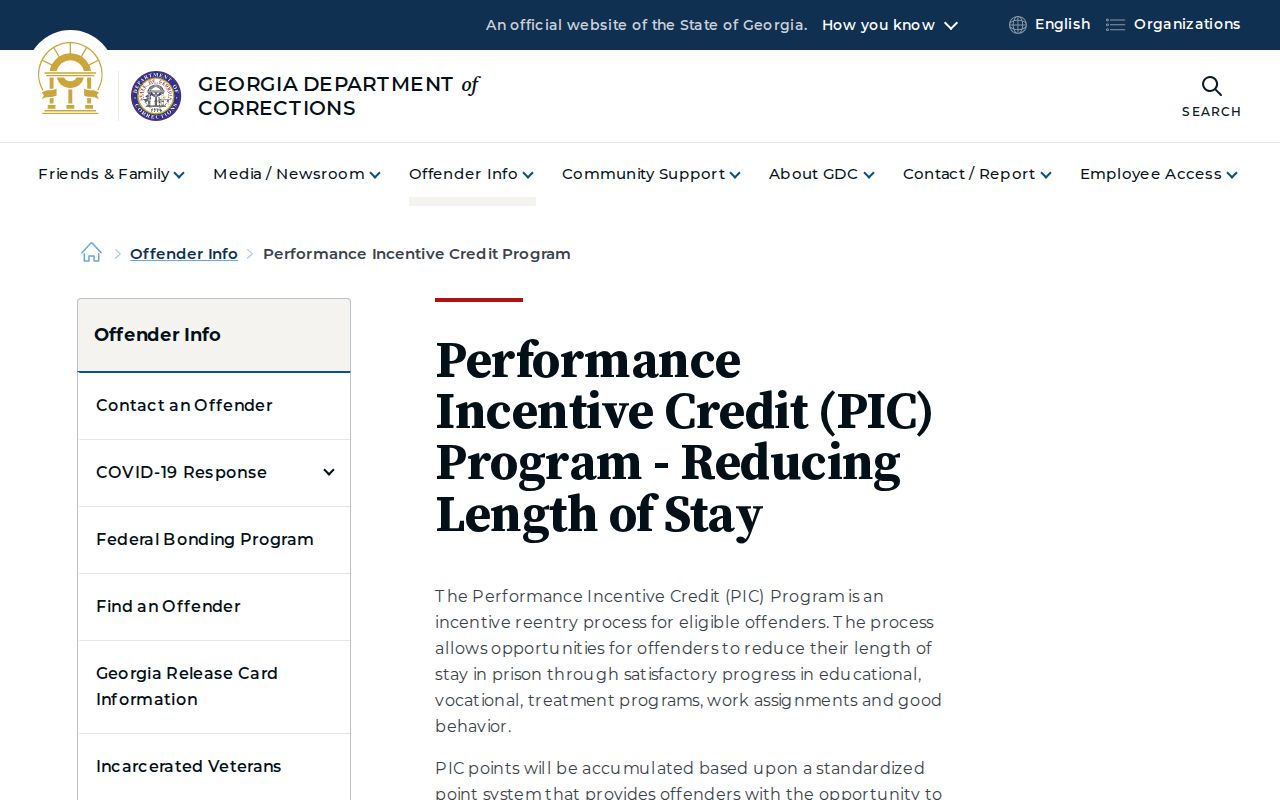
The image supports the state-credit path, which is distinct from earned time at Pike County Jail.
Life-sentence and serious violent felony cases need added care. PAP describes different eligibility periods based on the offense and crime date. It also identifies categories that are not parole eligible. A TPM should never be invented by applying the ordinary one-third benchmark to a case that falls under a statutory exception. The sentence order and PAP's current eligibility material control.
Why Pike Release Dates Change
A date changes when the facts used in the calculation change. The agency should identify the controlling factor rather than merely giving a new date.
| Factor | Possible effect | Where to verify |
|---|---|---|
| Jail credit correction | Moves sentence expiration | Jail and sentencing court |
| Earned time or forfeiture | Shortens or restores time within county rules | Pike County Jail |
| PIC credit | May reduce an eligible TPM or MRD | GDC record and PIC rules |
| Misconduct | Can postpone or cancel a TPM or affect credits | GDC and PAP |
| Amended sentence | Changes the legal term or credit | Pike Superior Court |
| Detainer or hold | Prevents community release or causes transfer | Holding and receiving agencies |
| Parole decision | Sets, changes, or denies a parole path | PAP |
A maximum date can also involve non-running time. A court order may correct the sentence. PAP can reconsider a prior decision up to release. Each event leaves a different record, so one portal rarely tells the whole story.
If a detainer appears, ask who issued it and whether the person will be transferred when Pike or GDC custody ends. A local release entry can record departure from the jail even while another authority takes custody. The receiving agency's locator or records office then becomes the correct source. Without that step, a technically accurate jail date can be wrongly described as a return to the community.
Confirm Pike County Release Dates
For a county sentence, contact Pike County Jail at 89 Jackson Street, Zebulon, and ask for the releasable booking and release record. For a GDC date, the public search is a strong locator, but GDC tells users to verify exact data through written correspondence with Inmate Records and Information, P.O. Box 1529, Forsyth, GA 31029.
A complete request should state which date needs confirmation. Ask whether the displayed value is a maximum release date, a projected calculation, a parole review month, or an actual discharge date. Include the full name and GDC ID. For Pike County Jail, give the booking date, local case number, sentence date, and date-of-birth details when known. Clear identifiers help staff separate overlapping cases and sentences.
Keep the answer tied to its source date. A printout may be correct when issued and later change after a credit adjustment, discipline, amended court order, or Board reconsideration. Check again near the anticipated event. When pickup or a legal filing depends on timing, ask whether release has been processed instead of relying on a calendar estimate.
Release time and release date are distinct. A court order entered on one day may take time to reach the jail and clear other holds. GDC can calculate an end date without predicting the hour of discharge. Pike jail staff own the local processing event, while GDC controls a state-prison discharge. A detainer may send the person directly into another agency's custody.
Georgia VINE can add a custody-change alert for a specific person when the participating agency supplies the record. It is not a certified historical archive. The Pike County VINELink check explains registration and alert limits. After an alert, confirm the release time, reason, or transfer with the jail, GDC, or court.
Note: “Not in custody” confirms only the named agency's status and may coexist with parole, probation, or custody elsewhere.
Pike Release Dates and 48/72 Hours
Georgia's 48-hour and 72-hour rules address early court presentation, not a public release list or a sentence projection. Under O.C.G.A. 17-4-26, an arrest under a warrant requires reasonable diligence in bringing the person before a judicial officer and, in any event, presentation within 72 hours. The rule can affect first appearance and bond timing.
For a warrantless arrest, O.C.G.A. 17-4-62 requires conveyance without delay and says a person not brought before a judicial officer within 48 hours shall be released. That legal event is not the same as earned-time release, a GDC maximum date, or a parole TPM.
Pike County publishes no official 72-hour release feed. To understand an early release, check Magistrate Court for first appearance and bond, then ask the jail for the actual release event and any hold. A case can also move to Superior Court, Probate Court, or a municipal court based on the charge and issuing authority.
Note: A first-appearance deadline does not promise release if another lawful basis for custody remains.